
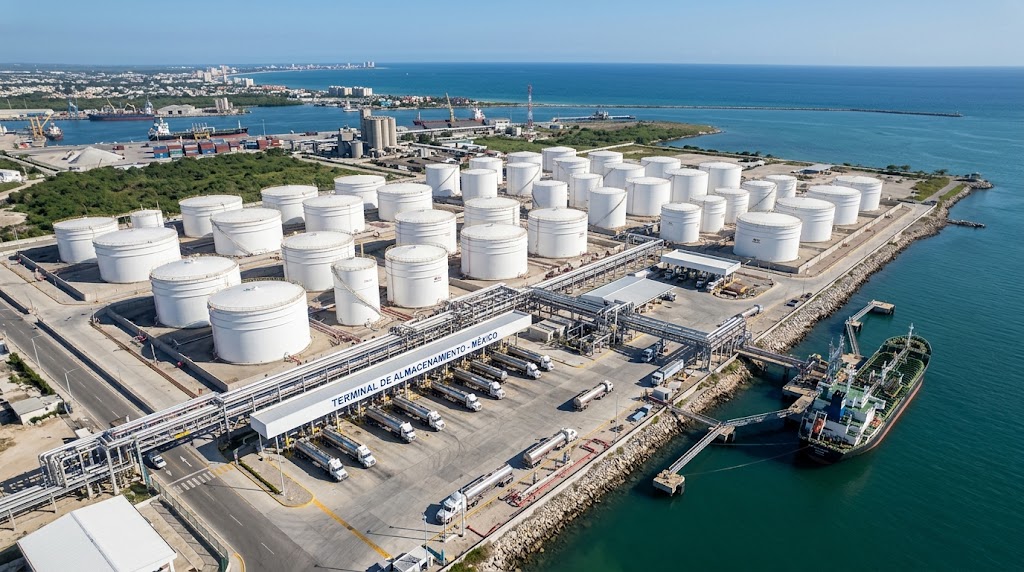
New regulations in Mexico requiring an increase in refined products storage capacity could help to shift market share to state-owned Pemex, making it more difficult for smaller companies to compete, according to importers, lawyers and consultants interviewed by S&P Global Platts. Beginning July 1, all importers and wholesalers of gasoline, diesel are required to have the equivalent of five days of supply stored in their facilities. Companies will have to report their monthly sales and imports to determine their inventory obligations. The regulations were initially issued in December 2017, prior to the Andres Manuel Lopez Obrador administration. However, sources are concerned that Lopez Obrador could use the new regulations to curb the participation of private players in Mexico’s energy sector, strengthening Pemex, one of his stated goals.
The bulk of the existing refined products storage terminals had been designed to maximize the operations of Pemex’s six refineries, when Mexico did not depend on imports, said Rosanety Barrios, a former government official who participated in the design of the storage policy. By the time of the policy proposal, however, Mexico was already importing 40% of its refined products demand and private importers were beginning to enter the market.
“We wanted to give private players an opportunity to build their own infrastructure,” said Barrios, who is now an independent consultant. The original goal was to gradually increase storage capacity to reach 15 days of storage by 2025 to better prepare the country for emergencies and improve its logistics, Barrios said. In December 2019, however, the Lopez Obrador administration modified this policy reducing the goal to 5 days and extending the beginning of the implementation to July 1. Mexico’s total refined products demand was 1.24 million b/d in March, before demand slumped in reaction to the coronavirus pandemic, according to the energy ministry, SENER.
That would suggest roughly 6.2 million barrels of storage capacity is needed to meet the five-day requirement. According to the country’s Energy Regulatory Commission, CRE, Mexico’s total installed storage capacity is 20.8 million barrels, but the number is not broken down into product type. Mexico ended March with 8.894 million barrels of gasoline in storage, according to SENER data. According to SENER, there are currently 88 terminals in the country, out of which 78 belong to Pemex. The other 10 storage terminals have a combined capacity of 5.15 million barrels, SENER data shows. Among the ten companies that have storage facilities are ExxonMobil, Invex Infraestructura, IEnova, Repsol, and Windstar.
The concentration of storage capacity in the Gulf and Northwest areas of Mexico presents a challenge for independent distributors in other regions, according to a June report by Mexico-based cosultancy Talanza Energy. In their analysis this concentration will make it impossible for some of those players to comply with the regulations. “I fear the country will continue to have storage facilities that are located far from the centers of demand, causing saturation,” Barrios said, adding that Pemex could use its abundant storage capacity to exercise its market dominance.
CRE and SENER could not be reached for comment. STORAGE TICKET OPTION According to the new regulation, importers and wholesalers can comply with the minimum capacity by either building infrastructure or securing it through the purchase of a ticket. Failing to do so can result in their import permits being revoked by the CRE. Building storage facilities was not easy for smaller players, due to a lack of existing infrastructure and because of regulatory bureaucracy, said Marcial Diaz, a Mexico-based consultant said.
Storage permits would take very long to get and the government frequently asked companies to invest more than what was originally agreed, Diaz said. Tickets, on the other hand, can only be obtained by a company with excess storage capacity, and in most areas of Mexico the only company that has excess storage is Pemex, said Diego Campa, a partner specialized in Mexico’s energy sector at law firm Denton Lopez Velarde. Complying in these areas means accepting Pemex conditions and prices, and failing to reach an agreement with Pemex can take you out of business, Campa said. “Losing their permits is the main concern among industry members, particularly small wholesalers, but it also bothers them having to depend on Pemex,” he said, adding that there is the risk that Pemex unilaterally decides not to grant a ticket. “We are not there yet, but it’s a possible scenario,” he said. Pemex could not be reached for comment.
HARDER TO COMPETE
Even big companies which continue to sell fuels supplied by Pemex could be at risk if they have not built capacity or secured storage rights through tickets, said Santiago Arroyo, CEO at consultancy Ursus Energy. Arroyo has already approached Pemex to inquire about tickets, but said the rules under which they will operate have not been disclosed to him by Pemex. Other importers have told Platts they will also approach Pemex in order to comply. Buying tickets from Pemex is disadvantageous because the state oil company has the ability to dictate prices unilaterally, said a Mexico-based energy lawyer, who spoke on the condition of anonymity. “There being no rules for granting tickets, Pemex can deny them to eliminate competition,” the lawyer said. “I see a big number of wholesalers losing their permits and going out of business in the next couple of months,” Arroyo said. At least one judge has ruled in favor of an independent importer who argued that the rules for complying with the minimum storage policy have not yet been published fully. The judge granted the importer a temporary waiver from the regulations pending a final court decision, according to document seen by S&P Global Platts. Two more market participants told Platts they have obtained similar waivers.
“Taking big investment decisions in 2018 was difficult in Mexico, as the political environment in the country was changing,” said a former gasoline station owner who is now in the natural gas business. Investors were beginning to rethink their plans in the sector as election polls indicated that Lopez Obrador had a serious chance of winning the election, he said. President Lopez Obrador promised during his campaign to strengthen Pemex if he came to power and undo the new energy liberalization. “It was very disturbing to hear that when you were planning your strategy,” he said.
The government is also trying to curb the participation of private importers, hardening supervision and revoking permits for minor circumstances, two Mexico-based importers said. SENER is coordinating with Mexico’s tax authority and with customs authorities at the border to cancel permits from importers who don’t use the permits, or under-utilize them, they said. “If your imports vary to what you said, for whatever reason, even a valid one, you may lose your permit,” said one importer, who spoke on the condition of anonymity. “Even companies like Exxon have faced issues with import permits,” the Mexico-based lawyer said.
Exxon imports roughly 30% of the gasoline it sells in Mexico via rail through Kansas City Southern.An ExxonMobil spokesperson declined to comment. During March, the latest reading before the coronavirus pandemic hit, Mexico imported 1.16 million b/d of fuels, with Pemex importing 782,900 b/d of that, according to SENER. Total gasoline imports were 597,151 b/d, with Pemex responsible for 80% of the total.