
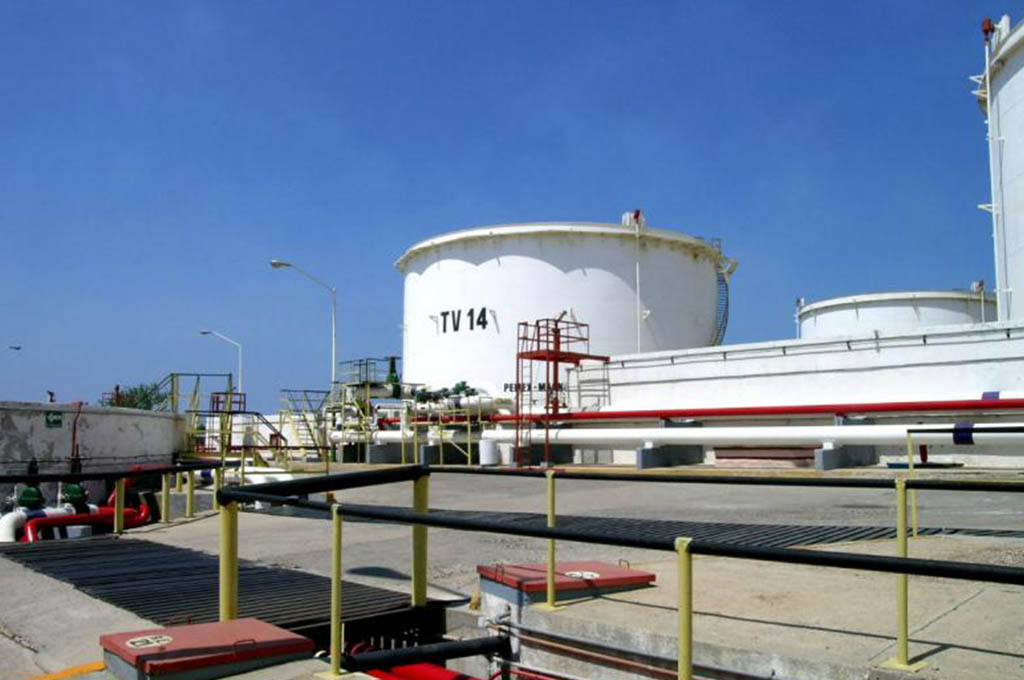
MEXICO CITY – Without enough access to fuel inventory tickets, companies might declare force majeure or seek legal injunctions against Mexico’s Public Policy on Minimum Fuel Inventories (PPMFI), market observers told OPIS. Mexico will implement its policy starting on July 1, requiring marketers and distributors to store five days of sales to end-users in strategic inventories. However, Pemex controls most of the country’s limited storage capacity. As a way to fulfill the policy, Mexico’s Energy Regulatory Commission (CRE) will oversee a ticket market where marketers and distributors without storage capacity can acquire the financial rights over inventories from another marketer. If market participants cannot secure tickets, they could resort to declaring force majeure to CRE about their inability to fulfill the terms of the policy, said Rosanety Barrios, a Mexico City-based independent energy analyst, told OPIS.
“No one is obligated to fulfill the impossible,” said Barrios, adding that companies would need documented evidence they were unable to secure inventory tickets to make the declaration. CRE has not published the final rules for the emission of tickets nor the penalties for those unable to fulfill the inventory policy.
“The lack of guidelines is submerging the industry in uncertainty,” Barrios added. OPIS on June 4 reported on a leaked draft of CRE ticket rules that ticket costs and contracting models will be set freely by the market following free economic competition rules. Companies unable to fulfill the policy could get their marketing permits revoked as the maximum penalty after multiple warnings, according to the drafted rules.
The risk of getting permits revoked considering Pemex’s dominant market position in the storage market and concerns about open access to acquire tickets is worrying, said Marcial Diaz, director of Mexican energy legal firm Lexoil. The policy began being implemented when CRE requested companies to voluntarily report their volume of inventories during the first half of June, Diaz said. Two Mexican fuel marketers told OPIS that it is likely that many companies will introduce injunctions against the PPMFI as those companies with storage capacity are trying to sell their tickets tied to long-term supply contracts.
“Sadly, all energy issues in Mexico are being solved by lawyers in courts and not by policy and energy experts,” Diaz said. Following the law, Mexico’s National Regulatory Enhancement Commission (CONAMER) would then review the ticket emission rules considering feedback from market participants. However, Mexico has released major policy and regulation without holding public consultations at CONAMER such as the Policy on Reliability, Security, and Continuity of the Power System on May 15, curtailing the entrance in the operation of private renewable generation projects, generating opposition from industry and the European Union and Canadian government.
The reliability policy has generated dozens of legal processes by private renewable generation projects that have led to court injunctions against the policy and the government. “What is happening with renewable energy operators might end up happening with the fuel sector where judges end deciding the fate of new projects, investments, and private market participation,” Diaz added. Under economic competition rules, Pemex should not tie the sale of inventory tickets to other services such as a supply contract, but the state company has offered tickets primarily to its marketers and distributors, Diaz said.
“Pemex is telling competitors to hold on the queue as it is fulfilling the ticket requirements from its associated marketers and branded distributors first,” he added. “We will see if COFECE (Mexico’s Antitrust Agency) will take cards on the issue and investigate ticket sales.” Another major concern is if fuel import permits granted by Mexico’s Energy Secretariat (SENER) will be conditioned to fulfilling the PPMFI requirements, Diaz said.
“At the moment authorities are requiring among other things that marketers have a storage contract to grant an import permit,” he added. The industry is concerned that the PPMFI could curtail competition, pulling Mexico back five years ago to the starting line of market liberalization, Diaz said. “We will end with a market with different retail stations brands and colors but all being supplied with Pemex fuel,” he added.